The 2022 release continues the Lincoln Shield series, approved in 2010 as a permanent reverse design.
The technological production process relies on using zinc blanks featuring an external galvanic coating.
- Core Material: 99.2% Zinc
- Plating Material: 0.8% Copper
- Weight: 2.50 grams
- Diameter: 19.05 mm
- Thickness: 1.52 mm
The electrolysis method used for applying copper creates an extremely thin protective layer easily susceptible to mechanical impact that affects the 2022 penny value.
Mintage Statistics and Production Volumes
US Mints maintained high emission rates in 2022 to meet the needs of the retail economic sector.
The total release volume exceeded 6 billion units, distributed between two primary production facilities.
| Mint Facility | Mint Mark | Mintage | Release Method |
| Philadelphia | None | 3,310,000,000 | Business Strike |
| Denver | D | 3,043,200,000 | Business Strike |
| San Francisco | S | 399,742 | Proof (Collector) |
Such figures confirm the absence of physical scarcity for coins in conditions up to MS66 inclusive.
Economic Aspects and Cost of Production
In 2022, the cost of producing a single one-cent coin amounted to approximately 2.72 cents.
This figure exceeded the face value of the item by more than twofold, marking a historical peak in minting expenses.
Rising prices for raw zinc and electricity directly impact the US Mint budget, provoking discussions regarding a potential change in alloy composition in the future.
Investors view the modern 2022 cent as a potential object for long-term metal accumulation, provided there is a change in currency circulation legislation.
Grading Analysis and Red (RD) Condition Criteria
The primary value of 2022 coins is concentrated in the RD (Red) category, designating the preservation of at least 95% of the original copper luster.
The appearance of any oxidation spots or surface darkening automatically shifts the coin to the Red-Brown (RB) or Brown (BN) category.
In these cases, the market value of the item drops to face value, failing to cover even shipping costs.
| Grade | 2022-P Price | 2022-D Price | Dynamics |
| MS67 RD | $12 | $15 | Stable |
| MS68 RD | $45 | $65 | +10% annually |
| MS69 RD | $350 | $750 | High Volatility |
A higher premium for the MS69 condition is recorded for 2022-D coins due to the smaller number of perfect specimens found compared to Philadelphia.
Auction Records and Market Indicators
Despite the novelty of the issue, transactions significantly exceeding face value have already been recorded in public trading.
In 2022, one of the first certified 2022-D specimens in PCGS MS69 RD grade was realized for $840 on the eBay platform.
Later sales in 2023 showed a price decrease to the $400-$500 level, caused by increasing supply in population registries.
The average annual price drop for top grades in the first 2-3 years after release usually totals about 15% due to initial market saturation.
However, for specimens in exceptional MS69 condition, the trend remains upward provided no new discoveries are made.
Population Report
Statistics from PCGS and NGC grading services clearly demonstrate the rarity of top scores for this year.
For the 2022-P issue, the number of coins in MS68 RD grade exceeds 300 units.
For the 2022-D issue, the number of coins in the same grade totals fewer than 100 units.
The gap in striking quality between the mints is explained by the varying condition of working dies and press pressure settings during specific production periods.
Locating a coin in MS69 RD condition is recognized as an event of exceptional rarity, considering the mass nature of packaging coins in 5,000-count bags.
Typical 2022 Minting Defects
The process of producing billions of coins inevitably involves the occurrence of technological errors.
A primary issue for the 2022 release is the presence of microscopic gas bubbles under the copper layer.
These swellings, called plating blisters, form during the galvanization of the blank.
The most frequently encountered defects include:
- Off-center image alignment
- Die wear traces appearing as radial lines in the fields
- Weak strikes of letters in the E PLURIBUS UNUM motto
- Surface scratches sustained during the coin’s fall into the hopper after the press strike
Any of the above markers deprives the coin of a chance to obtain an MS68 grade or higher.
Previous Decades
When comparing the 2022 cent to 2000s issues, an improvement in the overall detailing of the central shield section is noted.
The Mint applied updated master hubs providing sharper lines for the vertical stripes on the reverse.
From a long-term value perspective, 2022 shows similar dynamics to 2019 and 2020.
Specimens from 2019 in MS69 grade currently trade in the $150-$200 range, having lost about 50% of their peak initial value.
This confirms the rule of gradual price reduction as the number of certified coins in databases grows.
Identification Protocol
Searching for valuable 2022 coins requires the sequential execution of control procedures.
- Verifying the presence of the D mark to identify the more valuable Denver issue
- Using a 10x magnifying glass to inspect Lincoln’s cheek for micro-nicks
- Evaluating the cleanliness of the fields surrounding the reverse shield
- Checking for the absence of plating blisters, being a sign of future metal destruction
- Verifying the uniformity of the mint luster, excluding the presence of dull areas

Investment Risks and Storage Conditions
Working with modern zinc coins requires adherence to strict conservation rules.
Zinc is a chemically active metal reacting with moisture at the slightest damage to the copper layer.
Investing in uncertified (raw) coins carries a risk of 100% capital loss should corrosion appear.
To preserve the RD grade long-term, the following is necessary:
- Using acid-free polymer holders
- Storage in rooms with humidity not exceeding 40%
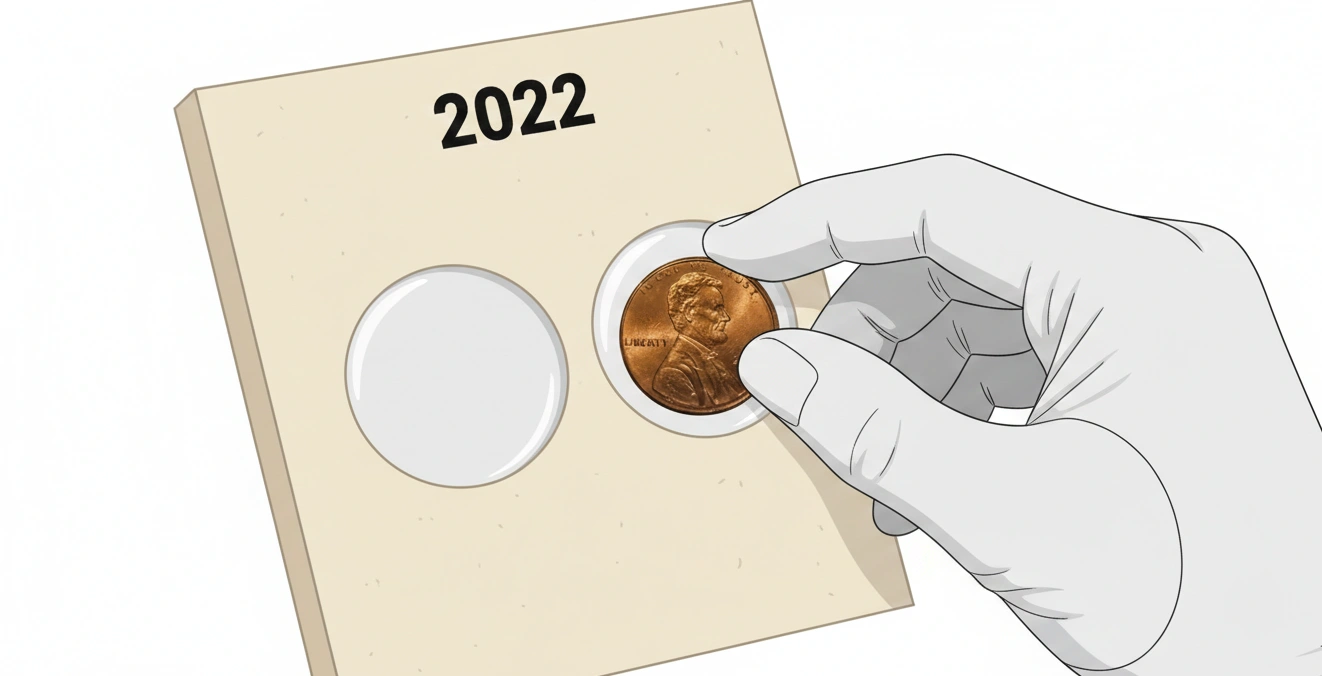
- Excluding direct skin contact with the coin surface
- Using airtight slabs from verified companies
Variety and Error Perspectives
Currently, no significant Double Die Obverse (DDO) varieties have been recorded for 2022.
The production process utilizing modern single-squeeze technology practically eliminates the appearance of classic doublings.
The primary potential for price growth is shifted toward planning errors, such as striking on blanks of a different denomination or using defective planchets.
The value of such confirmed errors can reach several thousand dollars immediately upon their discovery and certification.
Data Sources and Methodology
Price indicators in this article are based on the analysis of closed lots at Heritage and GreatCollections auctions.
Mintage data is provided by official US Treasury reports.
The population appraisal methodology considers only current registry data from certification services.
Growth and decline statistics are calculated based on median values for each preservation category.
The provided information is updated as new market reports on the state of the modern American numismatic sector appear.